
With a passion for turning data complexity into clarity, Jessica Sandifer is an experienced content manager who crafts stories that resonate across technical and business audiences. At DataGalaxy, she creates content and product marketing messages that demystify data governance and make AI-readiness actionable.
Data culture: How to build the high-performing, data-driven organization your teams need
25 November 2025 │ 8 mins read │ Data Culture by Jessica Sandifer, Tech writer
More than a buzzword, data culture is the shared mindset and operating system that determines whether your organization treats data as a strategic asset or an untapped byproduct.
As data & AI products become central to how companies create value, the need for a mature, governed, and collaborative data culture has never been greater.
Summary (TL;DR)
A strong data culture is now a defining driver of organizational competitiveness, especially as AI, automation, and real-time analytics reshape how companies operate.
Data culture aligns people, processes, and technology around trustworthy, governed, and accessible data—turning information into a strategic asset rather than an operational burden.
This article breaks down what data culture is, why it matters, and how organizations can build it using modern data & AI product governance platforms like DataGalaxy. You’ll learn the three pillars of data culture and practical steps to scale data-driven behavior across your company.
This article explores what data culture really is, why it’s now a strategic advantage, and how a platform like DataGalaxy helps organizations move from isolated data projects to a truly data-driven way of working.
What is data culture?
A data culture refers to the shared values, behaviors, processes, and expectations that encourage people across an organization to use data, not hierarchy, assumptions, or intuition, to guide decisions.
In a mature data culture:
- Evidence outweighs opinion
- Data is discoverable, trustworthy, and contextualized
- Teams collaborate using shared definitions and governed assets
- Decision-making becomes transparent, repeatable, and measurable
Data culture is foundational to data product management, data governance, and AI governance, all of which rely on a consistent, shared understanding of business and technical data entities.
Having a strong data culture requires five conditions:
- Accessible data – Employees can easily find and understand what data exists
- Trustworthy data – Quality, lineage, and governance are transparent
- Interpretable data – Clear definitions, business glossaries, and contextual metadata
- Governed data – Roles, ownership, policies, and controls are enforced
- Business-aligned data – Data connects directly to value creation
This transformation demands both leadership alignment and the right platform.
DataGalaxy, as a data & AI product governance platform, enables organizations to structure, share, and scale data knowledge in a collaborative environment.
Why having a strong data culture matters more than ever
Industry research consistently underscores the importance of data culture:
- Gartner ranks data culture as the top priority for Chief Data Officers.
- McKinsey describes it clearly: “Data culture is decision culture.”
- Forrester notes that insights-driven organizations are 3 times more likely to achieve double-digit growth.
A strong data culture is not a cosmetic initiative. It is a strategic capability that influences every part of the business.
The top 5 business benefits of having a strong data culture
1. Faster, higher-quality decision-making
Organizations without a data culture frequently deal with:
- Delayed decision cycles
- “HIPPO” decision-making (Highest-Paid Person’s Opinion)
- Inconsistent or duplicated reporting
- Low confidence in insights
With a healthy data culture:
- Teams evaluate facts, not hierarchy
- Data discovery is near-instant
- Business and technical teams share the same source of truth
- Employees align around measurable decisions
This shift dramatically accelerates strategy execution.
2. Higher employee engagement & organizational trust
Employees thrive when decisions feel:
- Transparent
- Logical
- Inclusive
- Evidence-based
When data becomes the foundation for communication and collaboration, teams experience less friction and more ownership.
3. Streamlined operations & reduced waste
A strong data culture reduces costly inefficiencies like:
- Report duplication
- Conflicting KPIs
- Manual data reconciliation
- Ambiguous terminology
With shared knowledge, a unified glossary, and clear lineage, operational bottlenecks shrink.
4. Improved revenue generation & customer experience
Data-driven organizations consistently outperform in:
- Customer personalization
- Market identification
- Campaign optimization
- Pricing decisions
- Product development
Data culture acts as a multiplier for revenue and innovation by enabling teams to respond proactively rather than reactively.
5. Better governance, lower risk, and stronger compliance
Data culture and data governance are inseparable.
A strong culture enables organizations to:
- Reduce regulatory exposure (e.g., GDPR, CCPA, AI Act)
- Improve audit readiness
- Strengthen access controls
- Monitor data quality
- Govern AI models responsibly
Instead of feeling restrictive, governance becomes a business enabler.
What happens without a data culture?
Organizations lacking a modern data culture experience predictable challenges:
Inefficient decision-making
Slow processes, limited transparency, and unclear ownership.
Strategic blind spots
Missed opportunities and misguided decisions due to incomplete or conflicting data.
Employee frustration
Teams feel unsupported, uninformed, or trapped in political decision-making.
Siloed data environments
Knowledge becomes tribal, and interdepartmental alignment breaks down.
Reduced competitive advantage
Data-driven competitors outpace you in innovation, speed, and customer responsiveness.
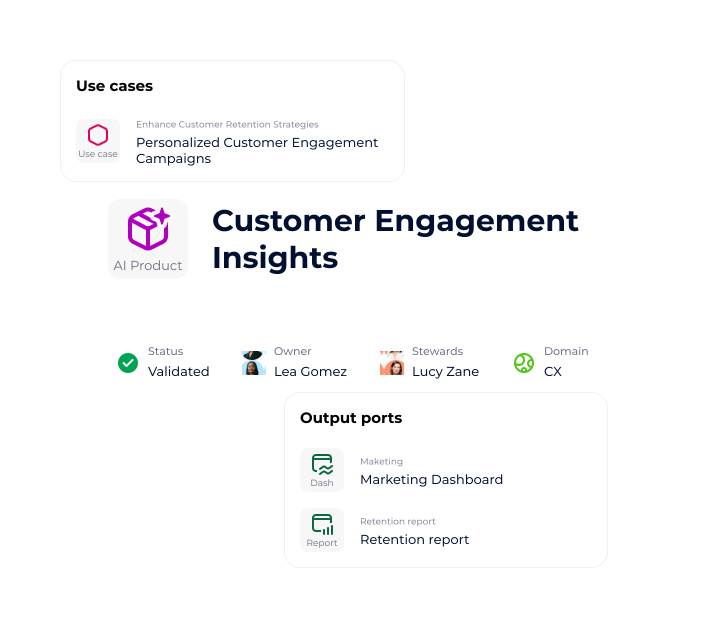
Find. Trust. Request. Use. Repeat.
Give business teams a dedicated space to explore, understand, and request trusted data without relying on support tickets. Discover the marketplace
The 3 pillars of a strong data culture
A scalable, sustainable data culture is built on three interconnected pillars:
1. Data search & discovery
Employees must be able to find the right data, at the right time, with full context.
Breakdowns occur when:
- Data is hidden across systems
- Metadata is outdated or incomplete
- Teams recreate work
- People rely on tribal knowledge
DataGalaxy supports this by providing a:
- Google-like semantic search
- Centralized Metadata & Business Glossary
- Fully mapped data products, dashboards, pipelines, and domains
- Collaborative knowledge capture & ownership visibility
- Automated lineage and impact analysis
2. Data literacy
Data literacy is the organizational ability to understand, interpret, and apply data effectively.
Employees should understand:
- Business definitions
- Data lineage
- Data quality indicators
- KPIs and their calculation methods
- Data product owners and stewards
DataGalaxy helps enable data literacy by providing:
- Embedded contextual definitions
- Visual lineage views
- Business and technical glossaries
- Data usage insights
- Collaborative documentation and knowledge sharing
Instead of formal training alone, literacy becomes a daily habit.
3. Data governance
Governance ensures data is:
- Accurate
- Secure
- Consistent
- Well-documented
- Compliant
- Appropriately used
Without governance, data culture collapses.
DataGalaxy helps reinforce good data governance habits by:
- Clear ownership and stewardship roles
- Automated policy enforcement & workflows
- Data quality scoring
- AI governance structures (model documentation, metadata, risk controls)
- Cross-domain governance modeling
Governance becomes a value driver—not a bottleneck.
You can’t buy a data culture, but you can buy the technology that makes it possible
You can’t purchase culture, but you can purchase the infrastructure that makes culture possible.
Tools reinforce behaviors. Behaviors reinforce culture. Culture reinforces value creation.
DataGalaxy acts as the connective tissue, providing:
- A unified data & AI knowledge hub
- A governed metadata ecosystem
- Collaborative product-focused workflows
- An intuitive experience for both business and technical teams
Technology doesn’t replace culture—it amplifies and scales it.
Designing data & AI products that deliver business value
How to build a sustainable data culture
To create long-lasting change, organizations must:
Align leadership around data-driven decision-making
Executives set the tone. If leadership doesn’t model data-first thinking, culture will not shift.
Democratize access to data knowledge
People cannot adopt what they cannot see.
DataGalaxy helps by centralizing:
- Definitions
- Lineage
- Technical metadata
- Data products
- AI assets
- Governance rules
Embed data into everyday workflows
Data should feel as natural as email or messaging.
DataGalaxy integrations bring context into the tools employees already use (BI tools, Slack, Teams, productivity suites).
Invest in data literacy & upskilling
Literacy is not optional. It is essential for modern organizations.
DataGalaxy simplifies this by delivering just-in-time learning through contextual metadata.
Implement governance without slowing innovation
Governance must be:
- Lightweight
- Automated
- Transparent
- Business-aligned
DataGalaxy provides workflow automation and modeling tools that keep governance seamless.
DataGalaxy: The ultimate platform for scaling data culture
DataGalaxy is more than a catalog. It is a data & AI product governance platform designed to align people, processes, and technology around shared data knowledge.
Organizations use DataGalaxy to:
- Build trusted, governed data products
- Democratize data knowledge
- Visualize lineage & business context
- Improve governance maturity
- Boost data literacy
- Strengthen AI governance
- Accelerate collaboration
- Create a sustainable data culture
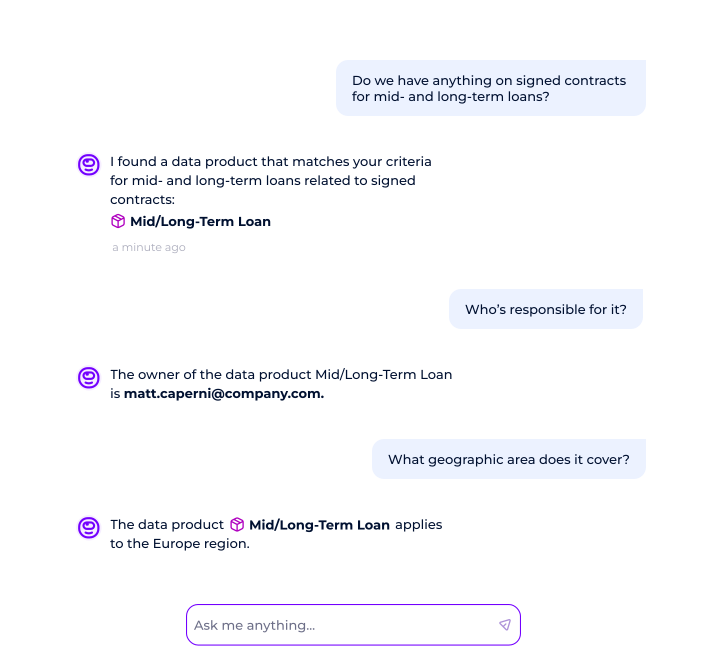
AI assistant for data discovery
Blink helps any user, technical or not, ask questions, find trusted answers, and take the next step with clarity.
Search in plain language and get answers backed by metadata, making data governance visible. Meet Blink!
DataGalaxy is:
- Easy to adopt
- Highly collaborative
- Intuitive for non-technical users
- Enterprise-ready
- Scalable across all domains
Building a strong data culture isn’t a single project. It’s an ongoing shift in how your organization thinks, collaborates, and decides.
The companies that will lead their markets are those that treat data and AI as governed products, empower people with shared knowledge, and embed data into everyday workflows.
By combining clear leadership, practical governance, and the right platform, you can turn culture from an abstract aspiration into a measurable capability.
With DataGalaxy as your data & AI product governance platform, you’re not just organizing metadata; you’re creating the conditions for faster decisions, smarter innovation, and a resilient data culture that compounds in value over time.
Key takeaways
- Data culture is essential for modern competitiveness.
- Organizations with strong data cultures outperform peers in speed, efficiency, and innovation.
- DataGalaxy provides the foundation for scalable data discovery, literacy, and governance.
- You can’t buy culture, but you can buy the platform that powers it.
- Long-term advantage comes from embedding data into everyday behavior.
FAQ
- Can a data catalog scale with my team as we grow?
-
Absolutely. A robust catalog supports multi-domain growth, role-based access, and metadata from an expanding tech stack. DataGalaxy is designed to grow with your needs — across teams, geographies, and governance maturity.
- How do you improve data quality?
-
Improving data quality starts with clear standards for accuracy, completeness, consistency, and timeliness. It involves profiling, fixing anomalies, and setting up controls to prevent future issues. Ongoing collaboration across teams ensures reliable data at scale.
- How do you build a data product?
-
Building a successful data product begins with a clear business need, trusted data, and user-focused design. DataGalaxy simplifies this process by centralizing data knowledge, fostering collaboration, and ensuring data clarity at every step. To create scalable, value-driven data products with confidence, explore how DataGalaxy can help at www.datagalaxy.com.
- How does DataGalaxy help teams manage the full lifecycle of a data product?
-
DataGalaxy provides templates, workflows, and structured fields to capture product definition, assign ownership, monitor lifecycle stages, track dependencies, and verify readiness for release. Lifecycle management covers design, build, documentation, deployment, updates, versioning, and retirement. Each stage is transparent and auditable.
- How does DataGalaxy help with regulatory compliance?
-
The platform includes role-based access (RBAC), SSO, audit trails, and admin control over every object and user permission.
Related posts

Gartner’s top 5 data & analytics predictions for new wave data teams in 2026
Did you know that Gartner estimates that by 2026, 90% of current analytics content consumers will become content creators enabled by AI? Leading analytics, research, and expert guidance firm, Gartner, recently shared their thoughts on the future of the data and analytics industry, including understanding how to work with emerging AI tools while ensuring high-quality data […]
Governance hype vs. business reality: Moving toward trust models
There’s a growing disconnect in many organizations: Governance is talked about as indispensable, yet it’s often treated as a checkbox. Leaders are eager to adopt data and AI strategies, invest in platforms, and hire data governance officers—but often, implementation lags. In this post, we explore Gartner’s finding that while nearly 89% of data and analytics […]
Marketplace: Where data products meet business strategy
Most data catalogs stop at organization. The Marketplace goes further, turning certified data assets into visible, reusable products directly linked to the use cases they support. This is not just about access. It’s about alignment. Keep reading to learn how to make your data reusable, discoverable, and aligned with real business goals. Why does the […]
What is a data maturity model, and why is it important? (2026)
Data is more than a byproduct of operations. It is now the currency of competitiveness and a catalyst for innovation. The challenge, however, is not in collecting data but in cultivating the data maturity to manage, interpret, and transform it into actionable intelligence. A data maturity model is a strategic framework to assess an organization’s […]
AI governance & stewardship: The next era of data value realization
AI innovation must be matched by equally powerful governance frameworks. However, across many industries, governance is frequently perceived as a limitation rather than a catalyst for positive business outcomes. Artificial intelligence isn’t just advancing. It’s multiplying in enterprise applications. In this article, we’ll explore two of the hottest trends in Gartner’s 2025 Hype Cycle: AI […]
The data observability market: Players & future outlook (2025)
From AI‑powered personalization to mission‑critical analytics, every decision relies on data that is timely, consistent, and trustworthy. From early niche adoption to mainstream business necessity, the data observability market has transformed into one of the fastest‑growing sectors in the data and analytics landscape. In 2025, organizations face unprecedented pressure to ensure the reliability, accuracy, and […]